

Putting
Shame
On The Map
Supporting youth sector practitioners and organisations to recognise, understand, and respond to shame — building connection where there has been disconnection.

Our Mission
Shifting Culture, Not Just Training
The Violence Intervention Project (VIP) has promoted Shame Informed Practice for 8 years through its Urban Therapy model, working with young people involved in serious youth violence and their families. Building on trauma-informed care, it helps professionals and organisations understand and respond to shame in themselves and the young people they support. The goal is not just training, but lasting organisational culture change.
“Shame… We all have it, no one wants to talk about it, and the less you talk about it the more you have it”
BRENÉ BROWN
Why It Matters
Why Shame-Informed
Practice Matters
Frontline professionals across youth work, education, social care and health regularly encounter shame; in young people, families, and themselves but lack the frameworks and tools to recognise or respond to it safely.
01
Fuels disconnection
Fuels disconnection, aggression, and self-destructive behaviours.
02
Catalyst for harm
Is a catalyst for violence, substance misuse, self-harm, and disengagement.
03
Reinforces inequalities
Reinforces systemic inequalities linked to race, gender, class, and identity.
04
Silences & weakens trust
Silences both professionals and service users, weakening relationships and trust.
Current trauma-informed and safeguarding frameworks address harm but often miss the role of shame as an underlying emotional mechanism.
For many young people, particularly those who’ve experienced care, exclusion, or marginalisation, shame is a powerful yet invisible force shaping how they see themselves and how they connect with others.

“Every violent episode I witnessed had a shame trigger. Shame is a sense of exposure and it’s terrifying because if someone else can see it, we feel we’ll drop down the hierarchy. So we use violence to convert that feeling of exposure to one of dominance.”
– JONATHAN ASSER, Award winning psychotherapist
The Shame Compass
Four Pathways of Shame
When people experience shame, they often move to one of four protective responses. These are not conscious choices, but ways of defending against painful feelings of exposure, rejection, or not being good enough.

Withdrawal
External Flight
Avoidance
Internal Flight
Attack Other
External Fight
Attack Self
Internal Flight
Pulling away from others to avoid further feelings of shame or exposure.
- Isolating from friends, family, or support networks
- Avoiding school, work, or social situations
- Hiding emotions behind silence or emotional shutdown
- Spending excessive time alone or disengaged
- Feeling invisible, disconnected, or detached
Trying to escape or numb shame through distraction, denial, or compulsive behaviours. Ranging from:
- Denying problems or pretending everything is fine
- Using humour, bravado, or distraction to deflect attention
- Using drugs, alcohol, or other substances and addictions
- Excessive gaming, gambling, or online activity
- Risk-taking or thrill-seeking behaviour
Attempting to move shame onto someone else through blame, aggression, or control.
- Public shaming, social media attacks, or humiliation
- Blaming others to avoid feeling vulnerable or exposed
- Shouting, arguing, or verbally abusing others
- Bullying, intimidation, or threatening behaviour
- Physical aggression, violence, or causing harm
Turning shame inward, leading to self-criticism and harm to one’s own sense of worth or wellbeing.
- Withdrawal from opportunities due to fear of failure
- Playing the victim, positioning oneself as powerless or unfairly treated to avoid responsibility
- Harsh self-criticism and feelings of worthlessness
- Self-harm or thoughts of self-punishment
- Depression, hopelessness, or suicidal thoughts
Click a section to explore each pathway
Click a section of the compass to explore each shame response pathway.
Shame compass adapted from D.L. Nathanson, Shame and Pride, 1992
Policy Alignment
Fitting With The
DfE Families First Programme
Aligning Values: Shame Initiative & Families First
The Shame Initiative aligns closely with the Families First ethos of early help, relational practice and whole-system collaboration. Both approaches recognise that families often disengage or escalate into crisis not because they lack motivation, but because shame, fear and mistrust shape how they interact with services.
Strengthening Relational Foundations Across Agencies
By helping practitioners across agencies understand and respond to shame dynamics in themselves as well as in the children, parents and carers they work with, the Initiative strengthens the relational foundations that Families First depends on.
A Framework for Trust, Practice & Cultural Change
It offers a framework for reflective, non-punitive professional practice that builds trust, supports strengths-based conversations, and reduces the adversarial experiences that can push families further from support. In this way, the Shame Initiative provides the cultural and psychological underpinning that enables Families First principles to be fully realised in day-to-day frontline work and leadership practice.
Our Offer
Two Pathways to
Shame-Informed Practice
Every organisation starts from a different place. Our dual model supports progression from professional learning to organisational culture change.
Pathway 1
Introductory
Workshop
Focus: Awareness and Professional Learning
This introductory tier builds a shared understanding of shame across your workforce. Through a core learning and development session, led by two expert facilitators (3 hours) and a follow up online 1 hour reflective session, participants explore:
- What shame is and how it operates in young people’s lives
- The impact of shame on engagement, identity, and behaviour
- How to recognise and respond to shame in restorative, relational ways
Pathway 2
Practice Leadership & Systems Change
Focus: Sustainability and Sector Learning
Reflection, feedback, and system alignment. For organisations ready to embed shame-informed practice as part of their culture
- Consultation with leaders about shame-informed principles and strategic objectives
- A series of three 2-hour workshops focused on applying learning in everyday practice
- Feedback and implementation plan to capture learning, identify barriers, and plan next steps
- Tailored consultancy and partnership, co-developing frameworks suited to your setting
- Organisation-specific practice champions group, facilitated monthly by VIP
“I really enjoyed the gentle and open space to invite perspective shift, backed up by self-effacing experience shared from the facilitators and participants. Great stuff.”
Workshop
Participant
“Following this session I want to straight away invite colleagues to seek out shame and use it as the start to switch into positive, impactful work.”
Participant
Reflection
“I’ll be working with a training session plan looking at where I might inadvertently evoke shame and have ways of creating more connection.”
Participant
Reflection
“Following this session I want to hold shame as a potential driver behind behaviour. Reflect on ways to acknowledge shame – without naming it directly”
Participant
Reflection
Published Work
Our Work IN THE MEDIA
Community Care
Article
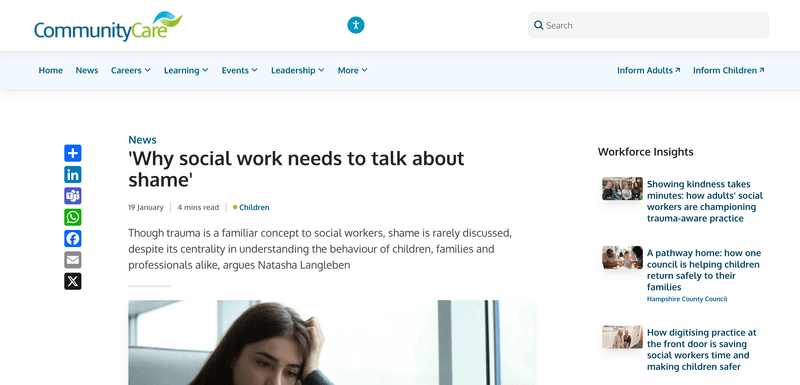
Why Social Work Needs to Talk About Shame
Professional Social Work
Article
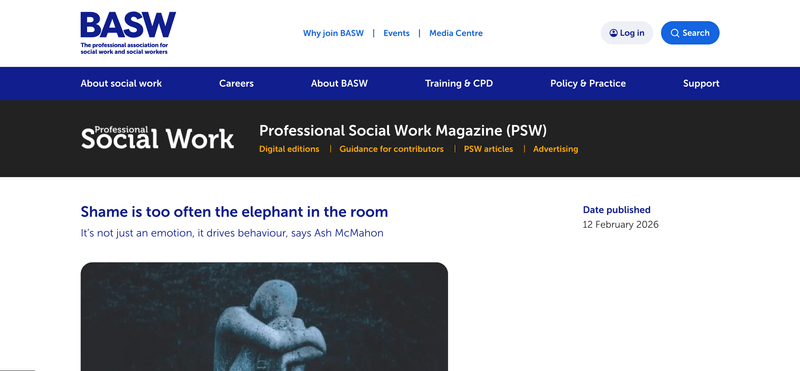
Shame: The Elephant in the Room
Substack Newsletter
Article
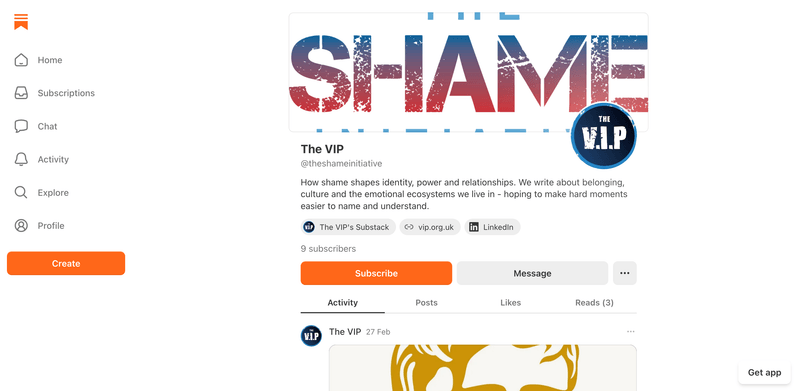
Shame Is In The Room
Partner With Us
Let’s Build Something Together
Together, we can build a more compassionate, connected youth sector – one that sees beyond behaviour, understands the power of shame, and creates the conditions for young people to thrive.
- A local authority or commissioner seeking to embed shame-informed practice
- A school, charity, or youth organisation developing trauma- or relationship-based approaches
- A funder or policymaker supporting workforce development and system change
Deprecated: json_decode(): Passing null to parameter #1 ($json) of type string is deprecated in /var/www/vhosts/theshameinitiative.org.uk/httpdocs/wp-content/plugins/bit-form/includes/Core/WorkFlow/WorkFlowHandler.php on line 99